Vladinsky Romanian, b. 1988


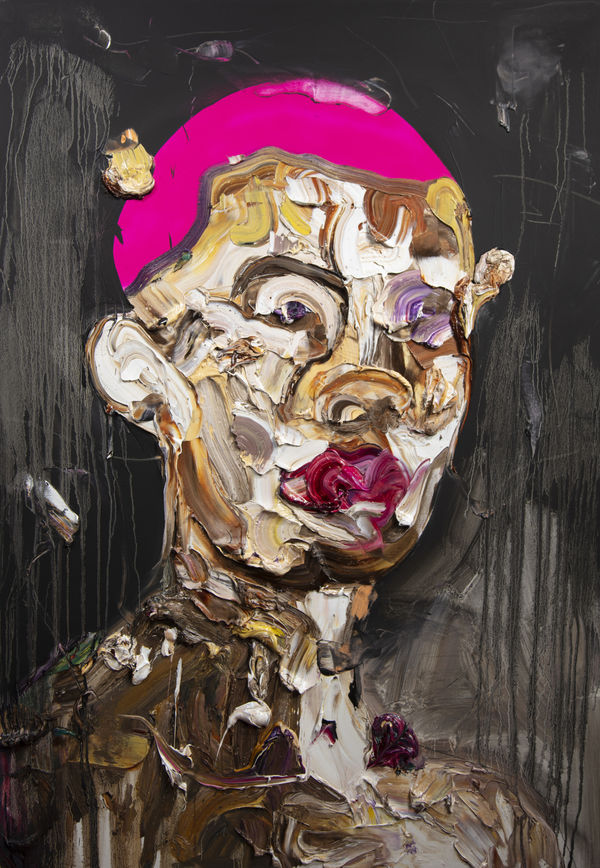

Vladinsky (b. Romania) is a contemporary visual artist known for his expressive mixed-media paintings that explore identity, perception, and the fragile boundary between inner psychological states and external representation. His work often combines figurative elements with abstraction, creating compositions where bodies appear calm and simplified while faces and surfaces dissolve into dense layers of material, texture, and color.
Working primarily with oil, acrylic, and mixed media on canvas, Vladinsky develops paintings that function simultaneously as emotional portraits and conceptual investigations. His practice frequently examines themes of authorship, self-doubt, and the shifting relationship between the artist, the viewer, and the creative process itself.
One of his most significant projects, Trying to Find the One Who Has Stolen My Talent, began as a personal inquiry after a vivid dream in which the artist questioned the ownership of his own ideas. The project evolved into a structured investigation composed of forty-six interconnected oil portraits, each acting as both suspect and witness within an open narrative about creativity, influence, and identity. The series was later expanded through the integration of artificial intelligence as a conceptual collaborator, exploring how technology might reinterpret or “steal” the visual language of the artist.
Alongside this project, Vladinsky continues to develop several bodies of work that move between figurative and abstract territories, including the ongoing Observer series. Through these works he investigates the psychological tension between what is visible and what remains hidden beneath the surface.
His practice is also closely connected to the idea of Functional Presentism, a conceptual framework that explores the relationship between contemporary art and spatial design. Within this approach, artworks are not only autonomous aesthetic objects but also functional visual anchors that complete and activate architectural and interior environments.